
Professional Concrete Patio Installation for Beautiful Outdoor Living Spaces
A professionally installed concrete patio creates a durable foundation for entertaining, relaxing, and enjoying your property. MasterAZScapes provides concrete patio installation services for homeowners and commercial property owners looking to create attractive, functional outdoor areas. Whether you’re building a new patio, expanding an existing outdoor living space, or incorporating hardscaping into a larger landscape design, our experienced team helps develop solutions that complement your property.
Concrete offers design versatility, durability, and a variety of finishing options. However, achieving a successful project requires careful planning, appropriate ground preparation, and installation methods that account for drainage, soil conditions, and intended use.
Let’s Bring Your Landscaping Ideas to Life!
Have a project in mind? From beautiful patios to custom outdoor living spaces, our team is ready to help you explore the possibilities. Tell us about your project using the form below, and let’s get started!
"*" indicates required fields
Expert Concrete Patio Planning and Site Preparation
A quality concrete patio begins with the work completed before the concrete is poured.
MasterAZScapes considers the property’s existing conditions, proposed patio dimensions, surrounding structures, and how water moves across the landscape.
Evaluating Soil Conditions and Effective Drainage
Proper site preparation helps establish a stable foundation and reduces preventable installation problems.
Depending on the property, preparation may involve excavation, removing unsuitable soil, compacting the subgrade, and installing appropriate supporting materials.
Effective drainage is particularly important because improperly graded patios can direct rainwater toward buildings or allow pooling near the surface.
The proposed patio elevation and slope should be evaluated before construction begins.
Concrete Placement, Finishing, and Curing
After the site is prepared, forms establish the patio’s shape, dimensions, and finished elevation.
Concrete placement should account for appropriate slab thickness, reinforcement where specified, and correctly positioned control joints.
Control joints help manage shrinkage-related cracking, although they cannot eliminate the possibility of cracks entirely.
Finishing methods influence the patio’s texture and appearance, while proper curing supports strength development and long-term performance.
Customized Concrete Patio Installation Solutions
Traditional Poured Concrete Patios
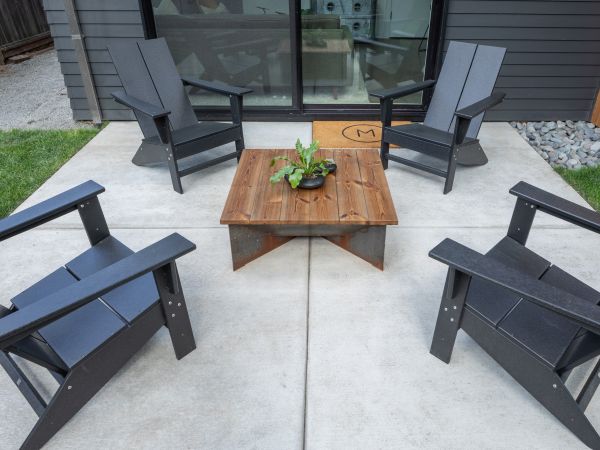
Poured concrete patios offer a relatively continuous surface suitable for outdoor furniture, dining areas, and everyday gatherings.
They can be incorporated into residential backyards, commercial courtyards, and other designated outdoor spaces.
Our landscape planning considers how the patio connects with surrounding pathways, planting areas, and existing hardscaping.
Decorative Concrete Patio Designs
Decorative concrete allows property owners to personalize the appearance of their outdoor surfaces.
Depending on the project, finish options may include broom textures, stamped patterns, or coloring techniques.
Material and finish selections should account for traction, environmental exposure, and the property’s architectural style.
Concrete Patios Integrated with Landscape Features
Concrete patios can complement outdoor kitchens, seating areas, walkways, and landscaped gathering spaces.
Property owners may also consider concrete pavers as an alternative to poured concrete.
Pavers offer individual modular units, while poured concrete provides a more continuous surface. The appropriate choice depends on appearance, maintenance expectations, drainage, and project requirements.
Professional Installation Methods for Long-Term Patio Performance
Concrete is a durable construction material, but proper installation is essential to achieving dependable results.
Important construction considerations include:
- Accurate Layout: Establishing appropriate patio dimensions and transitions.
- Stable Subgrade: Preparing the underlying soil to support the finished slab.
- Drainage Planning: Providing suitable slopes and managing surrounding runoff.
- Appropriate Materials: Selecting concrete mixtures and reinforcement suited to the intended application.
- Control Joint Placement: Helping manage shrinkage-related cracking.
- Proper Curing: Supporting concrete strength development and surface durability.
Weather conditions also influence concrete installation. Temperature, humidity, wind, and direct sunlight may affect placement, finishing, and curing practices.
Professional planning helps address these conditions before they compromise the finished product.
Why Choose MasterAZScapes for Concrete Patio Installation?
Established in 2008, MasterAZScapes is a locally owned landscaping company with 40 years of stated industry experience.
Our team approaches patio installation as part of a complete outdoor improvement, considering functionality, appearance, and long-term landscape integration.
Our qualifications and customer-focused practices include:
- Arizona Registrar of Contractors licensing
- BBB accreditation
- Certified arborist expertise
- Free project estimates
- Experience working with homeowner associations
- Material and workmanship warranties, subject to applicable terms
We emphasize clear communication, thoughtful material selection, and installation methods suited to the property’s conditions.
Customer Reviews and Concrete Patio Installation Experiences
Here’s what customers are saying about working with MasterAZScapes.


Create Your Outdoor Living Space with MasterAZScapes
A professionally designed concrete patio can create a more comfortable and functional outdoor environment while complementing your property’s existing landscape.
Contact MasterAZScapes today to request a free concrete patio installation estimate. Our team can help you explore patio layouts, finishes, and construction options suited to your outdoor living goals.
Frequently Asked Questions About Concrete Patio Installation
The cost of professional concrete patio installation depends on the patio’s size, site conditions, thickness, design complexity, and selected finish.
A basic poured concrete patio with straightforward access and minimal site preparation typically involves different costs than a decorative patio requiring extensive excavation, grading, reinforcement, or specialized finishing techniques.
Existing soil conditions may also affect the project. Unstable ground, drainage problems, or significant elevation changes can require additional preparation before concrete placement.
Decorative finishes, such as stamping or coloring, may increase material and labor costs compared with standard finishes.
Property owners should also consider whether the project includes steps, retaining features, pathways, or connections to existing hardscaping.
When comparing estimates, review the proposed excavation, base preparation, concrete specifications, joint placement, finishing, and curing requirements.
The lowest initial estimate may not represent the most appropriate construction approach.
MasterAZScapes offers free estimates to help customers understand the scope of their patio project and evaluate suitable design and installation options.
Poured concrete and concrete pavers can both create attractive outdoor surfaces, but they offer different advantages.
A poured concrete patio provides a relatively continuous surface that can complement modern outdoor designs and accommodate different textures or decorative finishes.
Concrete pavers consist of individual units installed over a prepared base. They provide design flexibility and may allow individual damaged sections to be replaced without removing an entire slab.
However, paver installations require proper base preparation, edge restraints, and joint maintenance.
Poured concrete patios may develop cracks over time due to shrinkage, ground movement, or environmental conditions. Appropriate control joints and installation practices can help manage certain cracking risks.
Both options require consideration of drainage, intended traffic, material durability, and long-term maintenance.
The preferred choice depends on the property’s layout, design goals, available budget, and how the outdoor area will be used.
MasterAZScapes can help property owners compare patio materials within the context of their overall landscaping plans.
The time required for concrete patio installation depends on the project’s size, site accessibility, preparation requirements, weather conditions, and selected finish.
A relatively simple patio with stable soil and straightforward access may require less construction time than a large installation involving extensive excavation, grading, drainage improvements, or decorative concrete treatments.
The process generally begins with site preparation and establishing the patio’s layout.
Forms are then installed, supporting materials and reinforcement are placed where required, and concrete is poured and finished.
After placement, concrete needs appropriate curing time before the patio can be used.
Although the visible installation work may be completed within a relatively short period, curing continues after the surface has hardened.
Weather conditions can influence scheduling, particularly when high temperatures, wind, or rainfall affect placement and curing practices.
Homeowners should request a project-specific schedule that accounts for both construction and the recommended waiting period before use.
MasterAZScapes can discuss anticipated installation steps during the estimate process.
A typical residential concrete patio designed for pedestrian use is often approximately four inches thick, but the appropriate thickness depends on site conditions, intended loads, and applicable construction requirements.
Patios supporting unusually heavy equipment, substantial outdoor structures, or vehicle traffic may require different slab designs.
Soil stability, base preparation, reinforcement, and drainage also influence long-term performance.
A slab that is adequately thick but installed over poorly prepared ground may still experience settlement or cracking.
Control joints should be planned according to the slab’s dimensions and construction requirements to help manage shrinkage-related cracking.
Property owners should also consider whether future additions, such as an outdoor kitchen or permanent shade structure, may require separate foundations or specialized support.
These requirements should be evaluated before concrete is placed rather than after the patio has been completed.
Professional installation involves selecting appropriate construction details based on the intended application.
MasterAZScapes can help assess the proposed patio layout and identify preparation considerations that should be addressed during project planning.
The waiting period before using a newly installed concrete patio depends on the concrete mixture, curing conditions, and the loads the surface will support.
Concrete begins developing strength after placement, but the curing process continues for an extended period.
Under appropriate conditions, some residential patios may accommodate limited foot traffic within a few days. However, the installer should provide specific guidance based on the concrete used and the conditions during placement.
Heavy furniture, grills, outdoor kitchens, or other concentrated loads may require additional waiting time.
Concrete strength is commonly evaluated using a 28-day reference period, although strength development varies by mixture and curing conditions.
Proper curing helps maintain moisture and temperature conditions that support strength development.
Premature loading, inadequate curing, or exposure to unfavorable environmental conditions may affect the finished surface.
Property owners should follow the installer’s recommendations regarding foot traffic, furniture placement, cleaning, and protective measures.
Allowing appropriate curing time helps support the patio’s durability and long-term performance.